
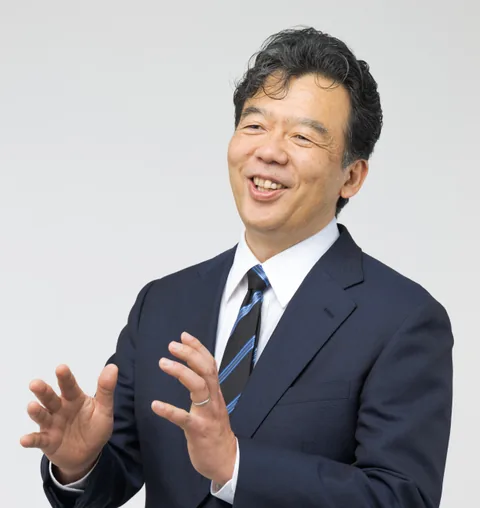
Hideaki “Hirdy” Miyamoto
Professor, The University of Tokyo
Professor in the Department of Systems Innovation, Graduate School of Engineering, and the Department of Earth and Planetary Science, Graduate School of Science.
Director of the Center for Space Resources and Innovation (CSRI). PhD, The University of Tokyo.
Principal Investigator, Lunar Dielectric Analyzer (LDA)
A lunar surface instrument for NASA’s Artemis programme
His research in planetary science and space resources examines the surfaces, materials, physical conditions and environments of the Moon, Mars and asteroids to understand their origins and evolution and explore possibilities for resource use. He combines spacecraft data, laboratory experiments and numerical modelling with the development of new exploration and measurement techniques.
Selected mission roles
- Artemis / LDA
- Principal Investigator, Lunar Dielectric AnalyzerLunar surface instrument selected by NASA in 2024 for astronaut deployment.
- MMX
- Science Board member; PI, SSG-SSTA founding member of the mission; leads the Surface Science and Geology Science subteam.
- TSUKIMI
- Science PI; board memberLunar resource exploration science.
- Hayabusa2
- Co-InvestigatorExploration of asteroid Ryugu.
- Kaguya / SELENE
- Co-InvestigatorLunar science and exploration.
- Hayabusa
- Co-InvestigatorExploration of asteroid Itokawa.
Additional mission participation
Akatsuki (PLANET-C) · LUPEX · Hera · Dragonfly
NASA announcement of LDA selection ↗
International appointments
Adelaide University, Australia — Adjunct Professor
Planetary Science Institute, USA — Senior Research Affiliate
Google Scholar ↗ ORCID ↗ researchmap ↗ University faculty profile ↗
Selected honours
Academic year 2025 — Dean’s Commendation, Graduate School of Engineering, The University of Tokyo ↗
2024 — MEXT Award for Science and Technology ↗
2024 — NASA Group Achievement Award
As a member of the International Mars Ice Mapper Measurement Definition Team, recognised for multidisciplinary science assessments supporting the mission concept.
2021 — Commendation from the President of the University of Tokyo
For good practice in online and hybrid teaching. Recipients (PDF, Japanese) ↗
2010 — Asahi Prize
As a member of the Hayabusa project team.
Additional honours
2012 — DSA Special Award for Planning and Research
2011 and 2008 — SDA Award, Spatial/Environmental Expression Sign Section
Media appearances, conversations and public lectures
NHK: Shiten Ronten (broadcast in July 2026)
Commentary on Japan’s role in the Artemis programme. Broadcast record (Japanese) ↗
BS TV Tokyo: Imakara Science (29 April 2026)
Discussion of lunar resources and the future of space exploration. Official programme page (Japanese) ↗
IMAGINE University: Conversation with Kenichiro Mogi (published 4 May 2026)
Mars, space resources and humanity’s future. Watch on YouTube (Japanese) ↗
Tokyo Forum 2025: Capitalism and Space
Moderator of an international panel exploring the science, governance and ethics of space resource use. Official overview ↗ Watch the discussion ↗
More public lectures and interviews
UTokyo Channel (2026)
A public dialogue on obtaining resources in space and expanding human activity beyond Earth. Watch (Japanese) ↗
UTokyo Metaverse School of Engineering × Sony (14 September 2024)
A lecture on resources across the Solar System and their potential uses. Programme (Japanese) ↗
Forbes JAPAN (3 June 2023)
An interview on space resources research and future industries. Read (Japanese) ↗
The University of Tokyo Newspaper (17 July 2023)
An interview on planetary exploration and humanity’s future beyond Earth. Read (Japanese) ↗
Selected earlier research coverage and appearances
Yomiuri Shimbun (5 January 2022, morning edition, p. 33)
Coverage of Mount Fuji field research to prepare for the MMX mission.
Nihon Keizai Shimbun (Nikkei) (9 March 2018, morning edition, p. 35)
A feature on Miyamoto’s work in space resource development.
National Geographic: MARS promotional event (17 November 2016)
A public appearance discussing Mars exploration and human settlement. Event coverage (Japanese) ↗
Space.com and Scientific American (2007)
Coverage of his first-author Science paper on regolith migration and sorting on asteroid Itokawa. Space.com ↗ Scientific American ↗ Research paper ↗
Outreach — Public engagement with science
He helped establish the TeNQ Space Museum at Tokyo Dome City and served as Director of the TeNQ Research Center for nine years. By bringing a working research laboratory into the museum, he helped visitors encounter research in progress and learn about the latest findings directly from scientists.
He proposed and developed the School Mobile Museum initiative, turning school classrooms and other local spaces into science exhibitions. Through exhibition supervision, public talks and collaborations with schools, he works to make Solar System science and other advanced sciences accessible to school students and the wider public.
TeNQ Research Center and educational activities (PDF, Japanese) ↗
Background, former appointments and committee service
Background
1995 — BSc in Geology, The University of Tokyo
1997 — MSc in Geology, The University of Tokyo
2000 — PhD in Earth and Planetary Science, The University of Tokyo
2002–2004 — Visiting Scholar, Lunar and Planetary Laboratory, University of Arizona
2006–2016 — Associate Professor, University Museum, The University of Tokyo
Since December 2016 — Professor, Graduate Schools of Engineering and Science, The University of Tokyo
Since 2025 — Director, Center for Space Resources and Innovation (CSRI)
Former appointments
Adviser to the President, The University of Tokyo (2025)
Special Advisor to the Dean, Graduate School of Engineering, The University of Tokyo (2023–2024)
Head, Department of Systems Innovation, Graduate School of Engineering, The University of Tokyo (April 2021–March 2023)
Visiting Professor, Institute of Space and Astronautical Science, JAXA (April 2019–March 2021)
Selected committee service
Member, International Space Exploration Committee, JAXA Institute of Space and Astronautical Science, fourth term (FY2023–2025). Official roster (Japanese) ↗